In 1991, there was a Korean soap opera that captured my attention. Eyes of Dawn was the first Korean blockbuster, which was produced by Jonghak Kim and written by Jina Song, well-known for their other work, 1995’s Sandglass. The drama, based on a novel with same title, attracted a lot of attention even before it began broadcasting because 6 million dollars were invested into the production for 36 episodes, and it was filmed on location in Korea, China, Japan, and Philippines. It dealt with the journey of three main characters, Yeo-ok, Dae-chi and Harim during their lives between the Japanese colonial period and the end of Korean War in 1953.
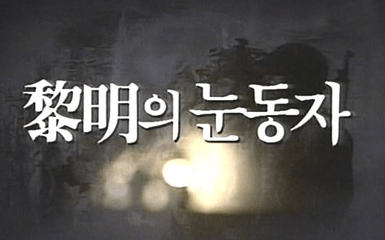 The teaser that showed a tear dropping down from Dae-chi’s knife-scarred eye is still vivid in my memory. I was so young that I could not understand the characters’ fickleness of fortune, but I was quite bewitched by scenes in which bullets zipped through the air amidst a war or Japanese soldiers chased Harim out of the prison. Afterwards, when broadcast again on a cable channel in 10 years, it did not fail to fascinate me, and I could fully understand its story. It ran amidst rising popularity with wonderful directing, solid story lines, actors’ superb performances and even perfect music.
The purpose of this program was both to entertain and inform. In fact, I became aware of the “Comfort Women” issue for the first time through watching this drama. It is believed that the Japanese army forced as many as 200,000 women in Asia to work as prostitutes for its soldiers in battle areas. A lot of Korean women were deceived into thinking that they would be sent to munitions factory. At the end of the war, some of them were massacred by the troops, and surviving comfort women have suffered permanent injury from disease, psychological trauma, or social ostracism. Furthermore, it also covered such important events in Korea’s modern history, such as a medical experiment on living human bodies in the Japanese 731 Corp, the Chinese Eighth Route Army, Korean War, 4.3 Resistance in Jeju and North Korean partisans.
 June-Young Lee