In 2001, I took a backpack trip to Europe during my first summer vacation in college. When I got home to Busan as a semester finished, my mother already bought round-trip ticket, departing for Heathrow airport in London. It was scheduled a week later, so having no time to be surprised by my mother’s action, I started to get myself ready to leave, reading Lonely Planet, the most famous travel guide. It was too busy to change won into traveler’s checks or other countries’ currency, because at that time, there was no Euro, a single European currency. Leaving my family and home, I took Korean Airlines with my heart aflutter in anticipation of the trip. Just the thought of being abroad and alone made me restless. I arrived at Heathrow airport in the evening. After getting the map at an information center, I walked around in London to find an accommodation, carrying a heavy knapsack. Wandering from place to place and asking passer-bys for directions, I found an old but cheap hotel. It was drizzling outside the window, and I was lonely and tired mentally and physically. My first impression about London was chilly and hard. It was rainy, as usual in London, and unlike most Americans, who seem friendly, people looked very ice-cold and strict.
Arirang
The next day, beginning with the Changing of the Guards at Buckingham Palace, I looked around many sightseeing attractions, such as Tower Bridge, Big Ben, Westminster Abbey and Saint Paul’s Cathedral. Busking was impressive on the streets. To attract visitors’ attention, some played musical instruments, and others, dressed up with their makeup, performed mime. Now I see a lot of street performers in San Francisco, but it was hard to see those kinds of buskers in Korea in 2001. After 10 days of travel in England, I crossed the Straits of Dover vi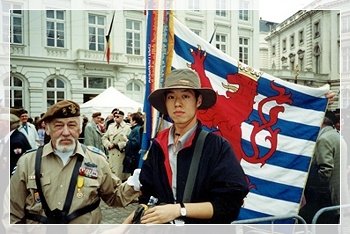 a the Euro Line, and reached Brussels in Belgium. At that time, there was a parade to celebrate Veterans’ day, and I saw a group with a Korean national flag. Gladly looking at them, I took some pictures of them, and some people in the group spoke to me and asked if I was Korean. Then, they told me that they participated in the Korean War in 1950s and started singing “Arirang,” which is a Korean traditional elegy. In fact, the song expresses “Han,” the unique emotion of Koreans, which is similar with the feeling of sorrow or lamentation but cannot be exactly explained or translated in English. While singing the song, they held my hands firmly and were completely moved to tears. It seemed that they understood the feeling only Koreans have in the song’s lyrics. I was really grateful of their courage and sacrifices fighting for my country and bowed down in deference to them.
 June-Young Lee