KOREA!

After I traveled through Italy, Austria, and Spain, I arrived in the Czech Republic. I was able to see a great many Korean backpackers on the train. All of them were heading for a soccer game between Korea and the Czech Republic, scheduled on August 15th, which is the Independence Day of Korea. As I reached the stadium, Red Devils, the cheering squad for Korean national soccer team, and Korean residents already filled seats up. The Stadium was already in wild excitement, and I was so excited about the prospect of seeing Guss Hidink, the head coach and Korean players. Several groups of police officers were deployed and enclosed the stadium for possible mayhem of hooligans. I met five backpackers there, and we planned some special performance before the game began. Six of us took off our shirts, and wrote six letters: K,O,R,E,A, and ! on each of our chests with lipstick we borrowed from a Korean female resident. I got the “O.” Accidently, we were captured by cameras of some Korean broadcast groups, who came over there to relay the game. Thinking as if we were pro-independence fighters, all of us yelled and sang songs to cheer the Korean national team until we were horse. The game result was 5-0. We lost. The Czech Republic already failed to move up to the next year’s World Cup finals. But, as though they wreaked their anger upon the Korean team, Czech players showed great performance behind the striking power of Jan Koller who is 6’7’’. I was so furious but cheered the players up.


1000 lira

I headed toward Italy by way of Belgium and Germany. In the train, I accidently met a couple of Korean travelers and got some information sharing trip stories. I think the real charm of traveling is to feel fresh, having new experiences with new people in new places, getting out of monotonously repetitive daily life. As leaving behind Korea two weeks ago, I enjoyed myself traveling alone. I walked toward the Coloseum as soon as I arrived in Rome. As it was described in lots of movies, the largest of the Roman Amphitheaters exuded an atmosphere of greatness and majesty the Roman Empire once had.

When I was about to leave there after I did sightseeing, some people all dressed in the Roman Empire costume came up to me. They suddenly grabbed my camera and started taking a picture of me with some of them. I thought that they provided visitors with this splendid service sponsored by a city government. But, after taking some photos, they asked me to pay for it. Now I am familiar with the tipping culture for street performance since I moved to San Francisco, which is famous for busking, but at that time I did not understand why they expected me to pay. Unwillingly, I gave them 1000 lira, but they began getting mad at me. (A lira was the unit of money used in Italy, but now it has been replaced by the euro.) They had every right to be pissed off because it was about fifty cents worth in those days. I could not afford to pay more as a hungry backpacker. After the five-minute of haggling over the tip, I got out of there with my camera.

My first backpacking trip

In 2001, I took a backpack trip to Europe during my first summer vacation in college. When I got home to Busan as a semester finished, my mother already bought round-trip ticket, departing for Heathrow airport in London. It was scheduled a week later, so having no time to be surprised by my mother’s action, I started to get myself ready to leave, reading Lonely Planet, the most famous travel guide. It was too busy to change won into traveler’s checks or other countries’ currency, because at that time, there was no Euro, a single European currency. Leaving my family and home, I took Korean Airlines with my heart aflutter in anticipation of the trip. Just the thought of being abroad and alone made me restless. I arrived at Heathrow airport in the evening. After getting the map at an information center, I walked around in London to find an accommodation, carrying a heavy knapsack. Wandering from place to place and asking passer-bys for directions, I found an old but cheap hotel. It was drizzling outside the window, and I was lonely and tired mentally and physically. My first impression about London was chilly and hard. It was rainy, as usual in London, and unlike most Americans, who seem friendly, people looked very ice-cold and strict.


Arirang


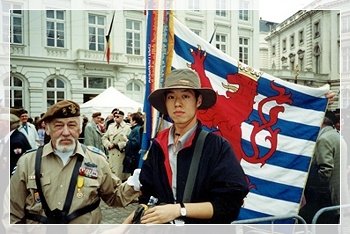
The next day, beginning with the Changing of the Guards at Buckingham Palace, I looked around many sightseeing attractions, such as Tower Bridge, Big Ben, Westminster Abbey and Saint Paul’s Cathedral. Busking was impressive on the streets. To attract visitors’ attention, some played musical instruments, and others, dressed up with their makeup, performed mime. Now I see a lot of street performers in San Francisco, but it was hard to see those kinds of buskers in Korea in 2001. After 10 days of travel in England, I crossed the Straits of Dover vibelgiuma the Euro Line, and reached Brussels in Belgium. At that time, there was a parade to celebrate Veterans’ day, and I saw a group with a Korean national flag. Gladly looking at them, I took some pictures of them, and some people in the group spoke to me and asked if I was Korean. Then, they told me that they participated in the Korean War in 1950s and started singing “Arirang,” which is a Korean traditional elegy. In fact, the song expresses “Han,” the unique emotion of Koreans, which is similar with the feeling of sorrow or lamentation but cannot be exactly explained or translated in English. While singing the song, they held my hands firmly and were completely moved to tears. It seemed that they understood the feeling only Koreans have in the song’s lyrics. I was really grateful of their courage and sacrifices fighting for my country and bowed down in deference to them.
Eyes of Dawn

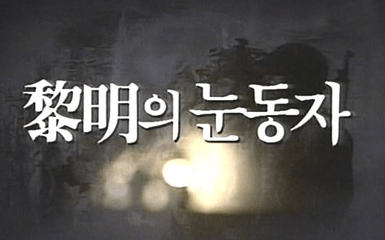
In 1991, there was a Korean soap opera that captured my attention. Eyes of Dawn was the first Korean blockbuster, which was produced by Jonghak Kim and written by Jina Song, well-known for their other work, 1995’s Sandglass. The drama, based on a novel with same title, attracted a lot of attention even before it began broadcasting because 6 million dollars were invested into the production for 36 episodes, and it was filmed on location in Korea, China, Japan, and Philippines. It dealt with the journey of three main characters, Yeo-ok, Dae-chi and Harim during their lives between the Japanese colonial period and the end of Korean War in 1953.

Screen Shot 2016-02-25 at 오전 11.10.57The teaser that showed a tear dropping down from Dae-chi’s knife-scarred eye is still vivid in my memory. I was so young that I could not understand the characters’ fickleness of fortune, but I was quite bewitched by scenes in which bullets zipped through the air amidst a war or Japanese soldiers chased Harim out of the prison. Afterwards, when broadcast again on a cable channel in 10 years, it did not fail to fascinate me, and I could fully understand its story. It ran amidst rising popularity with wonderful directing, solid story lines, actors’ superb performances and even perfect music.
The purpose of this program was both to entertain and inform. In fact, I became aware of the “Comfort Women” issue for the first time through watching this drama. It is believed that the Japanese army forced as many as 200,000 women in Asia to work as prostitutes for its soldiers in battle areas. A lot of Korean women were deceived into thinking that they would be sent to munitions factory. At the end of the war, some of them were massacred by the troops, and surviving comfort women have suffered permanent injury from disease, psychological trauma, or social ostracism. Furthermore, it also covered such important events in Korea’s modern history, such as a medical experiment on living human bodies in the Japanese 731 Corp, the Chinese Eighth Route Army, Korean War, 4.3 Resistance in Jeju and North Korean partisans.

To be indeed Son-Oh-Gong

In my adolescent years, I watched a lot of movies. When I lived in Gwang-An-Ri, there was an old videotape. It was a Chinese movie, entitled “Seo-Yu-Gi,” which is based on a novel with the same title. I have never forgotten the moment I watched this movie for the first time. A story of Oh-Gong’s journey with Samjang, Sa-Oh-Jeong, and Jeo-Pal-Gye was captivating. The main character, Oh-Gong had a long metal stick, which he named Yeo-Eu-Bong and flew in the sky while riding clouds. It totally fascinated me. A scene in which Oh-Gong kept away from the hand of Buddha after he peed in his hand made me frightened. I have seen the movie over one hundred times till the tape no longer worked.


Because of strong impression I got from the movie, I bought a toy stick, Yeo-Eu-Bong and brought it all the time as I pretended to be Oh-Gong. I was engrossed by playing-act Oh-Gong while hitting all of my relatives with the toy stick. My parents said that I always slept holding the stick every night.

MBC Newsdesk

Most parents in Korea normally do not allow their children to watch television, but my parents were different. They let me do that as long as I watched educational or instructive programs like documentaries or the news. I think it was permitted because my father had worked for MBC, a major broadcasting company in Korea for over thirty years.

The only way I could see my father’s face when I was young was by watching “MBC Newsdesk” every night at nine. My mother called me,

“June-Young, your father is on TV now. Come out.”

Then, I woke up, jumped out of my bed, and ran into a living room. Sitting in front of the TV, I watched the news while I kept saying, “It’s Dad.” In fact, I did not watch the news but just looked at my father.

My father, who was a news anchorman of “Newsdesk,” a main news program of MBC in Busan, came back home around 11 every night. He usually went to work before I got up in the morning, so I was barely able to see him during the time.

Sometimes my mother awoke me when my father was about to leave home for work, and I ran over to my father and held him tightly, saying, “Bye” and kissing him on his cheeks. I still remember the feeling when I touched my cheek to his cheek. It was smooth and warm. Twenty years later, while embracing him in the airport before I came to the U.S. to study abroad, his hug was still warm.

Toosiri’s diary

This world is full of stories and I have always enjoyed telling mine. I started writing so that I could grab  and memorize the moments. I liked to express emotion through my five senses with candid, pure words. I wrote over and over again till I could produce appropriate words from my heart, which were able to directly help people have the same feeling I experienced.  Fortunately, I won lots of prizes in writing contests. Once I received the prizes from my high school principal in front of all the students in my school, I felt like I was in heaven. I realized doing what I like and getting recognized for my work brought me a lot of happiness.

I believe that I got a gift and interest in writing from my parents. My father majored in Journalism, and my mother studied Korean literature in colleges. They first met each other at “Writing Friends,” a city-wide meeting for high school’s writing club in Busan, my hometown. Sometimes, my father won the first prize, and my mother won second place in national writing contests. They still have strong affection for literature.

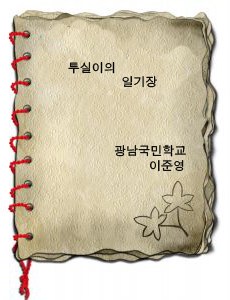
My mother was fairly fond of reading my diaries. She might have wondered what her son did during the day or what kind of thoughts he had. Eventually, she assembled my diaries and made a book which we called “Toosiri’s diary.” Toosiri means chubby in Korean. When I was young, I had fat on my cheeks, and my mother called me by that name. Looking at my mother smiling while she read my diaries, I desired to write better and better. I tried record my feelings for longer and in more detail. Thanks to my parents, my diary that I started writing due to my school assignment helped me become passionate about my writing.